

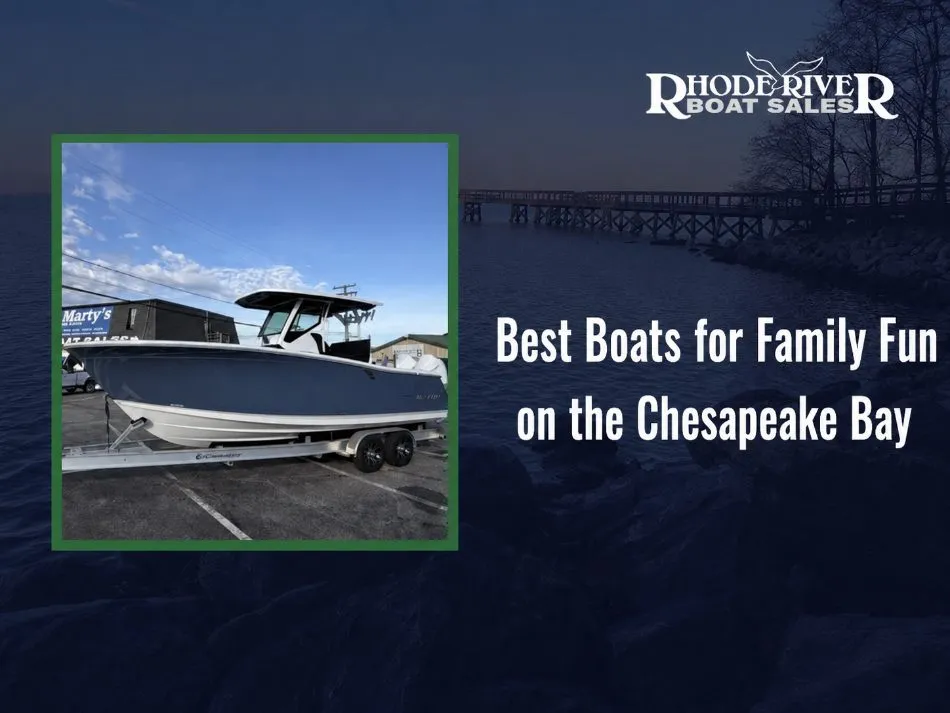
Best Boats for Family Fun
When peak Chesapeake summer arrives, the Bay fills with families looking to fish, swim, cruise, and spend long days on the water together.
Choosing the right family boat is what turns a hot July weekend into a memory rather than a hassle.
The best boats for this kind of use tend to combine:
- Comfortable seating
- Easy water access
- Shade
Enough capability to handle the Bay when the wind picks up in the afternoon.
This guide walks through:
- The boat styles that work well for family boating on the Chesapeake
- How to think about size and layout
- What to look for as you shop
- How we think about matching a boat to a family here in Edgewater, Maryland
What Makes a Good Family Boat for Chesapeake Summer
Chesapeake Bay boating has its own character.
The Bay is wide, relatively shallow in many areas, and known more for short, steep chop than long ocean swells.
Summer days often start calm and build a breeze by the afternoon.
A good family boat for these conditions usually balances comfort at rest with a hull that stays composed when the water gets bumpy on the ride home.
Common priorities when families tell us how they want to use a boat:
Seating and shade:
Room for everyone to sit comfortably, plus a T-top, hardtop, or bimini for sun protection during long summer days.
Easy water access:
A swim platform and boarding ladder make swimming, tubing, and getting kids in and out of the water far simpler.
Storage:
Space for coolers, safety gear, watersports equipment, and the inevitable pile of towels and bags.
A head compartment:
Even a simple enclosed head makes all-day outings with kids much more workable.
A stable, capable hull:
Enough size and deadrise to handle Bay chop without beating up passengers.
Best Boat Styles for Family Fun on the Bay
Dual Console Boats
Dual console boats are frequently recognized as one of the most family-friendly designs available, and this reputation is well-deserved.
These boats feature:
- A walkthrough windshield
- Two consoles positioned in front of a spacious cockpit
These provide families with a:
- Sheltered helm
- Ample seating
- Often a small enclosed head within one of the consoles
Industry evaluations consistently highlight dual consoles as a versatile option that effectively combines comfort, weather protection, and limited fishing capabilities, making them ideal for families seeking a well-rounded boating experience.
For families and water activities
For families primarily engaged in:
- Cruising
- Swimming
- Occasional fishing
A dual console boat represents an excellent choice.
While it offers slightly less 360-degree access for fishing compared to a center console, it strikes a favorable balance for those prioritizing a variety of recreational activities.
Center Console Boats
Center console boats feature a centrally positioned helm, allowing for an open deck design that is highly favored by avid anglers.
Contemporary center consoles have evolved to accommodate family use, incorporating additional seating at both the bow and stern, enhanced upholstery, and various amenities, all while retaining essential fishing capabilities.
As a result, a well-equipped center console serves as an effective crossover solution.
It provides the functionality needed for fishing while offering comfort for swimming and relaxation.
This versatility makes it an excellent choice for families prioritizing both fishing and leisure activities.
Bowriders and Deck Boats
For families who prioritize cruising, swimming, and watersports over fishing, bowriders and deck boats provide ample open seating and a sociable layout.
These boat styles are well-suited for day cruising and spending time with family and friends, featuring spacious bow seating and easy mobility throughout the vessel.
They are best utilized in protected waters and calmer conditions, rather than in open stretches of the Bay during rough afternoon waves.
Cabin Boats and Cruisers
Families seeking to enhance their day trips into overnight excursions, or those desiring additional shelter and amenities, should consider boats equipped with a:
- Cabin
- Berth
- Galley area
- Proper head
These features provide comfort and protection from the elements; however, they come with a higher purchase price and increased storage and maintenance requirements.
Such vessels are ideal for families planning to cruise to various destinations around the Bay and stay onboard.
How to Think About Boat Size for the Chesapeake
Sizing is one of the most common questions families ask, and the honest answer is that it depends on where and how you plan to boat.
For open-water Bay crossings with several passengers, experienced Chesapeake boaters frequently point toward boats in the mid-20-foot range and up, because smaller boats can get knocked around when the chop builds.
Comfort and confidence for a group of six to eight generally start climbing as you move into that mid-20s size and beyond.
Hull design matters as much as raw length
The classic Chesapeake workboat, the deadrise, developed its V-shaped hull over more than a century specifically to stay forgiving when the Bay turns rough.
In modern recreational boats, a deeper deadrise angle helps a hull cut through chop more smoothly, while a shallower hull rides flatter at anchor but can pound in waves.
Bay boats often use a moderate deadrise as a compromise between a soft ride and shallow-water access.
The takeaway
Match size and hull to your real use.
A boat you will mostly run in protected rivers and creeks can be smaller than one you plan to take across the main stem of the Bay on a breezy day.
It is also worth choosing a size you can realistically store, tow, and handle.
What Families Actually Do on the Water in Summer
Part of choosing the best boat is picturing how your family will use it.
Peak Chesapeake summer days tend to include a familiar mix of activities, and different boats support them to different degrees:
- Swimming and sandbar days, where a swim platform, ladder, and shade make the biggest difference.
- Tubing, wakeboarding, and other watersports, which reward open cockpit space and an appropriate, manufacturer-approved tow setup.
- Fishing for rockfish and other Bay species, where livewells, rod storage, and fishability matter.
- Cruising to waterfront restaurants and anchorages, where seating, a head, and weather protection add comfort.
- Simply relaxing at anchor, where stability and shade turn an afternoon into an event.
Why Choose Rhode River Boat Sales
Rhode River Boat Sales is a family-owned and operated boat dealership and brokerage in Edgewater, Maryland, serving Chesapeake Bay boaters since 1982.
Being based on the Bay near Annapolis means our team understands local conditions, how families actually use their boats here, and what to look for when matching a boat to your plans.
Here is how we help families find the right boat for peak Chesapeake summer:
New and pre-owned inventory:
We offer new models from Blackfin, Monterey, Bulls Bay, and Pioneer, along with a changing selection of pre-owned boats.
Honest guidance:
We focus on matching the boat to how your family boats, and we are candid about the tradeoffs of each layout rather than calling every boat perfect.
Financing assistance:
Financing may be available through third-party lending partners, subject to application, credit approval, and current program terms.
Trade-in options:
If you are moving up from a current boat, we can walk you through starting a trade-in evaluation.
Brokerage and listing support:
When it is time to sell, our team develops a marketing plan based on your boat, its condition, and the market.
Access to marina support:
Buyers can also access storage, parts, and service through the affiliated Rhode River Marina in Edgewater.
Contact Rhode River Boat Sales
To talk through options or arrange to see a boat, contact our sales team at (410) 798-4445. Contact the sales team to confirm availability and schedule a showing.
Frequently Asked Questions about Best Boats for Family Fun During Peak Chesapeake Summer
What is the best boat for fishing and family fun?
For families who want to both fish and enjoy general time on the water, a versatile crossover boat tends to work best. Well-equipped center consoles and dual consoles are frequently described as strong “do-it-all” platforms because they pair fishing features like rod storage and livewells with family-friendly seating, shade, and easy swim access. A center console offers more open fishing access, while a dual console typically offers more sheltered seating and comfort. The best choice depends on how much of your time is spent fishing versus cruising and swimming.
What type of boat is best for Chesapeake Bay?
There is no single best type, but boats designed to handle the Bay’s short, steep chop tend to share a capable V-shaped hull with enough deadrise to cut through waves. The traditional Chesapeake deadrise workboat earned its reputation for being forgiving when the Bay turns rough. For recreational families, versatile center consoles, dual consoles, and bay-style boats are popular because they balance a comfortable ride, stability, and the ability to fish or cruise. Match the hull and layout to whether you mostly run protected rivers or cross open water.
How big of a boat do you need for the Chesapeake Bay?
It depends on where you boat. For protected rivers and creeks, smaller boats can be perfectly enjoyable. For crossing open stretches of the Bay with a group, many experienced Chesapeake boaters suggest a boat in at least the mid-20-foot range, since smaller boats can get knocked around when the chop builds. Comfort and confidence for six to eight passengers generally improve as size increases into that range and beyond. Also consider a size you can realistically store, tow, and handle.
Are trimarans safe in rough seas?
Trimarans, which use a central hull flanked by two outrigger hulls, are generally regarded as stable and seaworthy in rough conditions thanks to their wide stance and centered weight, and many are built with buoyant, foam-filled construction that resists sinking. That said, any multihull can be pushed beyond its limits, and safety in rough seas always depends on the specific vessel, sea state, and seamanship. Trimarans are sailing multihulls rather than the powerboats commonly used for Chesapeake family boating, so for most Bay families the more relevant question is choosing a capable powerboat hull and practicing good judgment about weather.
What to do on a boat with family?
Peak Chesapeake summer offers plenty to do as a family: swimming and anchoring at sandbars, tubing and other watersports, fishing for local species, cruising to waterfront restaurants and anchorages, and simply relaxing at anchor in the shade. A boat with comfortable seating, a swim ladder, sun protection, and storage for coolers and gear makes all of these easier. Choosing a boat that supports your family’s favorite activities is a big part of picking the right one.
What is the safest boat for rough seas?
No boat is guaranteed safe in rough seas, and safety depends heavily on conditions, load, and the operator’s judgment. In general, a larger, well-designed hull with adequate deadrise and freeboard handles rough water better than a small, flat-bottomed boat, which is why deeper-V hulls are favored for choppy conditions. For Chesapeake families, the practical approach is choosing an appropriately sized, capable hull for the water you run, keeping proper safety equipment aboard, and watching the weather rather than relying on any boat to make rough conditions safe.
What month is the cheapest to buy a boat?
Boat prices tend to follow the season. Industry sources generally point to the fall and winter months, roughly September through February, as the best time to find deals, because demand drops, dealers work to clear current-year inventory, and sellers may want to avoid winter storage costs. Peak summer is typically the most expensive time to buy, since demand is highest. Buying in the off-season can also give you time to arrange service before the season starts. That said, the right boat at the right value can appear at any time, so it is worth watching current inventory.